Lunar Orbiter Image Recovery Project (LOIRP) Releases New High Resolution Image of the Ocean of Storms


Larger version
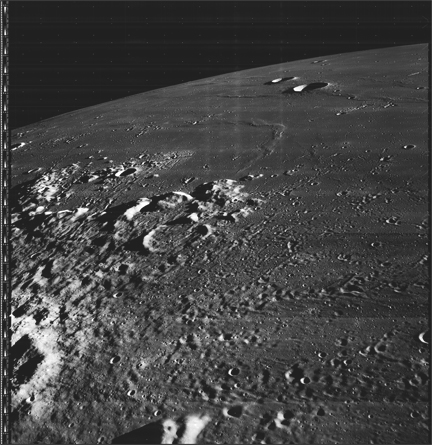
The Lunar Orbiter Image Recovery Project (LOIRP) has released a newly-retrieved, high resolution image taken of the lunar surface 42 years ago.
This image was taken by Lunar Orbiter III (LPI data) in February 1967. This oblique photo shows the region around the crater Galilaei and Planitia Descensus in Oceanus Procellarum (the Sea of Storms). In the upper center of the image you can see the Great Wall of Procellarum.
This image has been recovered in its original high resolution format from original Lunar Orbiter project data tapes using restored tape drive hardware and will eventually be submitted to the PDS (Planetary Data System).
LOIRP Note: We will be putting the full resolution version of this image on the NASA Lunar Science Institute website with the layers preserved for Photoshop for all you folks to have fun with! We only ask that you send us copies of what you do and credit us if you publish it anywhere.
For more information on the Lunar Orbiter Image Recovery Project (LOIRP) visit https://moonviews.wpenginepowered.com
For information on NASA’s Lunar Science Institute visit http://lunarscience.arc.nasa.gov/

Apple WWDC Lunchtime Session: Dennis Wingo of the Lunar Orbiter Image Recovery Project (LOIRP)

Thursday 12 June 2009: noon: Come hear Dennis Wingo of the Lunar Orbiter Image Recovery Project (LOIRP) discuss their use of Mac OS X technology to save our Space Race heritage. LOIRP is retrieving, digitizing and publishing high-resolution pictures of the Moon captured by five NASA space probes ahead of the Apollo 11 moon landings in 1969. These tapes – rescued from destruction by a determined NASA archivist – represent some of the highest-resolution pictures ever taken of the Moon’s surface and are a priceless piece of history.
More info at http://developer.apple.com/wwdc/sciencemedicine/

LOIRP Releases Lunar Orbiter Ranger 8 Impact Crater Image

The Lunar Orbiter II-070-H image (Frame 70, High resolution) has a unique feature that is relevant to the LCROSS mission. This image shows the impact site of the Ranger 8 mission. This location was identified decades ago and is discussed in the NASA SP-168 online address. This location was also photographed during the Apollo 16 mission (NASA SP-315 page 29-46) but at a lower resolution of 3-5 meters. The image was taken from an altitude of 45.81 km. The resolution is about 0.4 meters per pixel. The crater from the Ranger impact is not well defined in the existing film database, especially as it appears at the boundary between two framelets.
Figure 1 is the reproduced trajectory of the Ranger 8 mission from NASA SP-168:

Figure 1: Ranger 8 Impact Trajectory Overlay on LOII-070-H (NASA SP-168). Image credit: LOIRP
Click on image to enlarge

Figure 2 shows the detail of the projected impact point:

Figure 2: Ranger 8 Estimated Impact Point (Crater C1). Image credit: LOIRP. Click on image to enlarge

The scale of an entire framelet is ~200 meters. While the full framelet is not shown here, the ragged overlap between two framelets from the film version of the image has lead to a misleading conclusion regarding the size and the shape of the crater. Crater C1 was disputed as the location of the impact in another NASA document (SP-315). The Apollo 16 preliminary science report (SP-315) identifies crater C2 as the impact point of Ranger 8 because it is consistent with other craters photographed by the later Apollo missions. The central mound is a distinctive signature of these impacts. Figure 3 is a low resolution version of our updated image from the LOIRP scans. The full resolution image [2.9 GB tiff] can be downloaded here

Figure 3: LOIRP LOII-70-H Image (reduced resolution). Image credit: LOIRP. Click on image to enlarge

Figure 4 shows the enhanced detail available from the LOIRP analog data tapes. Since the contrast is muted due to the nature of the site, the dynamic range improvements are not as noticeable. In the digital domain the framelet edges can be repositioned to generate a super-resolution version of the image by scanning the tape multiple times. The central mound, which seems to be an indicator of these small craters (as discussed in NASA SP 315 for the SIV-B impacts) is clearly evident here. The dark surrounding ejecta blanket was not expected, which drove the early identification of crater C1 as the impact point. However, it is unclear if the light colored ejecta to the lower left is associated with crater C1 or C2.

Figure 4: Detail of LOII-070-H2-f-601-602. Image credit: LOIRP. Click on image to enlarge

From a science perspective we are able to discern the size of the crater to a precise number (12.5 meters), which can give the LCROSS team a ground truth for similarly sized spacecraft.
Posted by: Soderman/NLSI Staff Source: D. Wingo/ LOIRP

House of Representatives Honors Lunar Orbiter Image Recovery Project

HONORING THE LUNAR ORBITER IMAGE RECOVERY PROJECT
HON. ZOE LOFGREN
OF CALIFORNIA
IN THE HOUSE OF REPRESENTATIVES
Monday, April 27, 2009
Ms. ZOE LOFGREN of California. Madam Speaker, I rise to commend the Lunar Orbiter Image Recovery Project and all those who have contributed their time and effort to ensure that historic images and vital data from the Lunar Orbiter missions of the 1960s are not lost to future generations.
In 1965, Charles Byrne, an engineer with Bellcomm, Inc., had the foresight to propose that NASA record data from the Lunar Orbiter missions onto tape recorders. NASA agreed and the images returned from the Lunar Orbiters were backed up on AMPEX FR-900 tape drives. To date, these images are some of highest resolution images we have of the Moon. Those images include a high-resolution version of “Earthrise,” the first picture of the Earth from the Moon’s vantage point. Time Magazine has called this image “the photo of the century.” The tapes also contain the first stereo imagery of the Moon’s surface. Indeed, these are some of the best images of the Moon ever taken, far superior from those received from the Hubble telescope.

Continue reading “House of Representatives Honors Lunar Orbiter Image Recovery Project”

KTVU: Old NASA Tapes Reveal Stunning New Moon Images; Resolution Unparalleled

Old NASA Tapes Reveal Stunning New Moon Images; Resolution Unparalleled
KTVU looked at several images, and the detail and clarity are astonishing. It’s the difference between grainy 35mm film with several generations of degradation, and the 70mm film original.
“Dennis Wingo brought up NASA’s publicly released photo from August 23, 1966, called “Earthrise.” Time Magazine called it the “Photo of the Century” and it is certainly amazing even today. But on the next screen Wingo showed the digitized version from the original tracking station tapes. Zooming in on the first version, Earth looks a bit fuzzy, though you can make out cloud patterns. On the recovered version, you can see fog along the Chilean coast, ice floes near the Antarctic. It is truly astonishing.
“Using these and some other 1966 images, we may be able to help push NASA’s climate data back in time a full decade, which will help with climate change studies,” says Wingo.
On shots of the lunar surface, the first versions show a blurry shadow here, some grayish along the horizon. The digitized recovered image is crisp with the deep black of space hovering over a multi-shaded gray surface, almost as if you were looking out the window of some lunar highrise. You can see rocks the size of an office chair. Sharp shadows and almost a 3D effect.”

Full story and Video at KTVU

LOIRP in the News

Old Moon Images Get Modern Makeover, Fox
Old Moon Images Get Modern Makeover, LiveScience
“Dennis Wingo, LOIRP’s team leader, detailed the group’s work in progress during last week’s 40th Lunar and Planetary Science Conference. Teamed with SpaceRef.com, LOIRP’s saga is one of acquiring the last surviving Ampex FR-900 machinery that can play analog image data from the Lunar Orbiter spacecraft. Wingo noted that the work is backed by NASA’s Exploration Systems Mission Directorate, the space agency’s Innovative Partnership Program, along with private organizations, making it possible to overhaul old equipment, digitally upgrade and clean-up the imagery via software. LOIRP is located at NASA’s Ames Research Center at Moffett Field, Calif. There, project members are taking the analog data, converting it into digital form and reconstructing the images. By moving them into the digital domain, Wingo said, the photos now offer a higher dynamic range and resolution than the original pictures, he added. “We’re going to be releasing these to the whole world,” Wingo said. Use of the refreshed images, contrasted to what NASA’s upcoming Lunar Reconnaissance Orbiter (LRO) mission is slated to produce, has an immediate scientific benefit. That is, what is the frequency of impacts on the Moon’s already substantially crater-pocked surface? “We’ll be able to get crater counts,” Wingo told SPACE.com. “LRO imagery of the same terrain imaged decades ago will provide a crater count over the last 40 years.”

Restoring History

NASA’s early lunar images, in a new light, Los Angeles Times
“Rising over the battered surface of the moon, Earth loomed in a shimmering arc covered in a swirling skin of clouds. The image, taken in 1966 by NASA’s robotic probe Lunar Orbiter 1, presented a stunning juxtaposition of planet and moon that no earthling had ever seen before. It was dubbed the Picture of the Century. “The most beautiful thing I’d ever seen,” remembered Keith Cowing, who saw it as an 11-year-old and credited it with eventually luring him to work for NASA. But in the mad rush of discovery, even the breathtaking can get mislaid. But in the mad rush of discovery, even the breathtaking can get mislaid. NASA was so preoccupied with getting an astronaut to the moon ahead of the Soviets that little attention was paid to the mountains of scientific data that flowed back to Earth from its early space missions. The data, stored on miles of fragile tapes, grew into mountains that were packed up and sent to a government warehouse with crates of other stuff. And so they eventually came to the attention of Nancy Evans, a no-nonsense woman with flaming red hair that fit her sometimes-impatient nature.”

LOIRP Invited to Present at 2009 Santa Cruz Film Festival.

I am proud to announce that the LOIRP Image recovery project will be presenting a 3 minute video at the 2009 Santa Cruz Film Festival. This is a major northern California cultural event and probably the first time in 20 years that a space themed entry has been invited to present. This film festival is attended by thousands and the attendees represent the top tier of the cultural elite of the San Francisco and northern California, including the regents of the University of California system, political, and business leaders.
Website http://www.santacruzfilmfestival.org/
Our presentation will be themed “In Praise of Old Men”, which will be a 3 minute video, beginning with the original Lunar Orbiter program in the 1960’s and segueing to our image and video record of bringing the marvels of 1960’s technology back to life with a focus on the retirees who have been instrumental in our efforts. It is a praise of this incredibly competent generation that took us to the Moon, and who even in their golden years, are an inspiration to the younger generation in their abilities.
The video will end with some of the marvelous pictures of the Moon that we are getting now, and ending with an incredible image of the black and white Earth, lonely in the backdrop of space, derived from Lunar Orbiter I and V images.
At the end we will auction off three high resolution prints as part of a Charity event at the festival and our intrepid Center Director, Dr. Pete Worden will participate with the head of the film festival in the auction.
This will be a great way to bring the 60’s, the role of NASA in the popular culture of the era, and to honor the people who helped to make that a reality.
Dennis Wingo
LOIRP Project Lead

Lunar Orbiter Image Recovery Project (LOIRP) Progress Report 23 February 2009


Refurbished capstan motor. Copyright 2009 LOIRP reproduction or republication prohibited without prior written permission.


Ken and Nathan working on refurbished capstan motor. Copyright 2009 LOIRP reproduction or republication prohibited without prior written permission.


Ken working on refurbished capstan motor. Copyright 2009 LOIRP reproduction or republication prohibited without prior written permission.

Lunar Orbiter Image Recovery Project (LOIRP) Progress Report 19 February 2009

To: LOIRP Status
From: Dennis Wingo
Subject: Progress Report, Milestone ALERT! Folks Major milestones to report!
Demodulator
We have had a major milestone accomplished (well 98% of the way there). Figure 1 shows two framelets, from Lunar Orbiter II High Resolution image (we don’t know which one yet). Figure 2 shows our favorite image, the Lunar Orbiter 1 image of the Earth with two framelets that were captured from the undemodulated tape. The framelets that are stitched together are from LO-1-102.
This proves that we can demodulate random tapes from more than one Lunar Orbiter mission but it has also shown us what we have to do to get to full production mode. The demodulator must be ultra stable, however, the drive is still not to its original specification and so there is jitter in the signal. The new capstan motor should fix this as we have new belts, bearings, and the motor has been balanced back to its original specification. However, the the motor driver assembly that we built to use during the calibration process blew some power transistors and he had to come back down (he is in San Francisco) and pick up one of our spares. We have been building spares for the production process to keep the machines running and this is helping with the refurb process as well! We will have the capstan motor on Saturday and will install and align it on Monday.
Al Sturm is going back and doing some further refining of the demodulator design to account for some loss of demodulator lock on the signal found during the testing yesterday. This accounts for the striping that you see on the Lunar Orbiter II framelets that we captured and processed shown on the next pages. We have not found out what frame this is and it is possible (as I have looked through all of the LO-II images) that we have one that is not in the current database as one image is missing from the LPL database that may be ours. If this is true, then we are helping to fill out the complete LO image database for NASA. One final note, look at the final image and see the boulders sitting on the surface at the edge of the crater!
Software
Gordon Woodcock has done some test automated assemblies of a couple of framelets which looks like it will result in a workable and at least semi-automated process for framelet reassembly.
Second Machine
We are continuing to install new caps and refurbished subassemblies that Ken and I have modified for better operation. It is our plan to finish the motor replacements, upgrades, and testing on the primary machine to get it ready for production before finishing up the second drive. This is as our experience gained on the first drive and the design upgrades will make the second drive relatively easy to get going after the learning curve of working on the first machine.
Images
Figure 1 is an unknown high resolution image from Lunar Orbiter II. These are individual framelets and we are still searching to figure out which whole image that it is attached to. The lines through the images are artifacts from the demodulator that is not quite 100% working – yet. The image has boulders sitting on the surface quite easy to see. We have verified that the intrinsic resolution of these images is going to be very high, to be quantified further after we get the demod at 100% and the capstan motor replaced. Figure 2 is a composite from LO-I-102-H that we processed from the undemodulated tape.
Figure 1: Unidentified high resolution framelet from Lunar Orbiter II. Image LOIRP/NASA

Figure 2: composite from LO-I-102-H Larger image. Image LOIRP/NASA

Discussion
We are closing in on satisfying all of the milestones from this phase of our project and we are looking forward to getting the go ahead and funding to enter the production phase. It is our plan to take a series of new images with us to the Lunar and Planetary Science conference in Houston to show what can be done with data mining these old data sets. We expect to be able to digitize any tape at will by next week and have a set of images that are the high priority outputs. I am extremely proud of our team and what has been accomplished and look forward to providing this raw data and finished products for NASA’s exploration and science efforts.
Respectfully Submitted
Dennis Ray Wingo

Lunar Orbiter Image Recovery Project (LOIRP) Progress Report 5 February 2009

We are still making progress and this report will outline what has happened since the last report on January 20.
General Statement
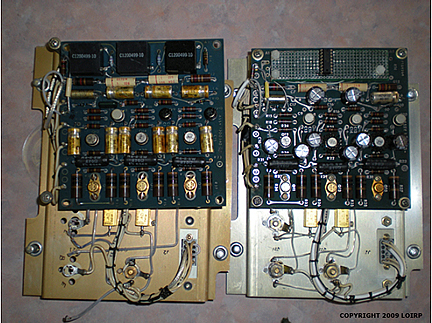
A bit of context is necessary here. The first machine continues to perform well. There are problems that were anticipated that we are dealing with. One of the overall reliability issues is that many electronic parts in the machine are customer Ampex hybrid circuits that are obviously not available anymore. Figure 1 shows what we have done to overcome this:

Figure 1: Capstan Motor Driver Assembly Before (left) and After (right) Modifications. Copyright 2009 LOIRP reproduction or republication prohibited without prior written permission.

Continue reading “Lunar Orbiter Image Recovery Project (LOIRP) Progress Report 5 February 2009”